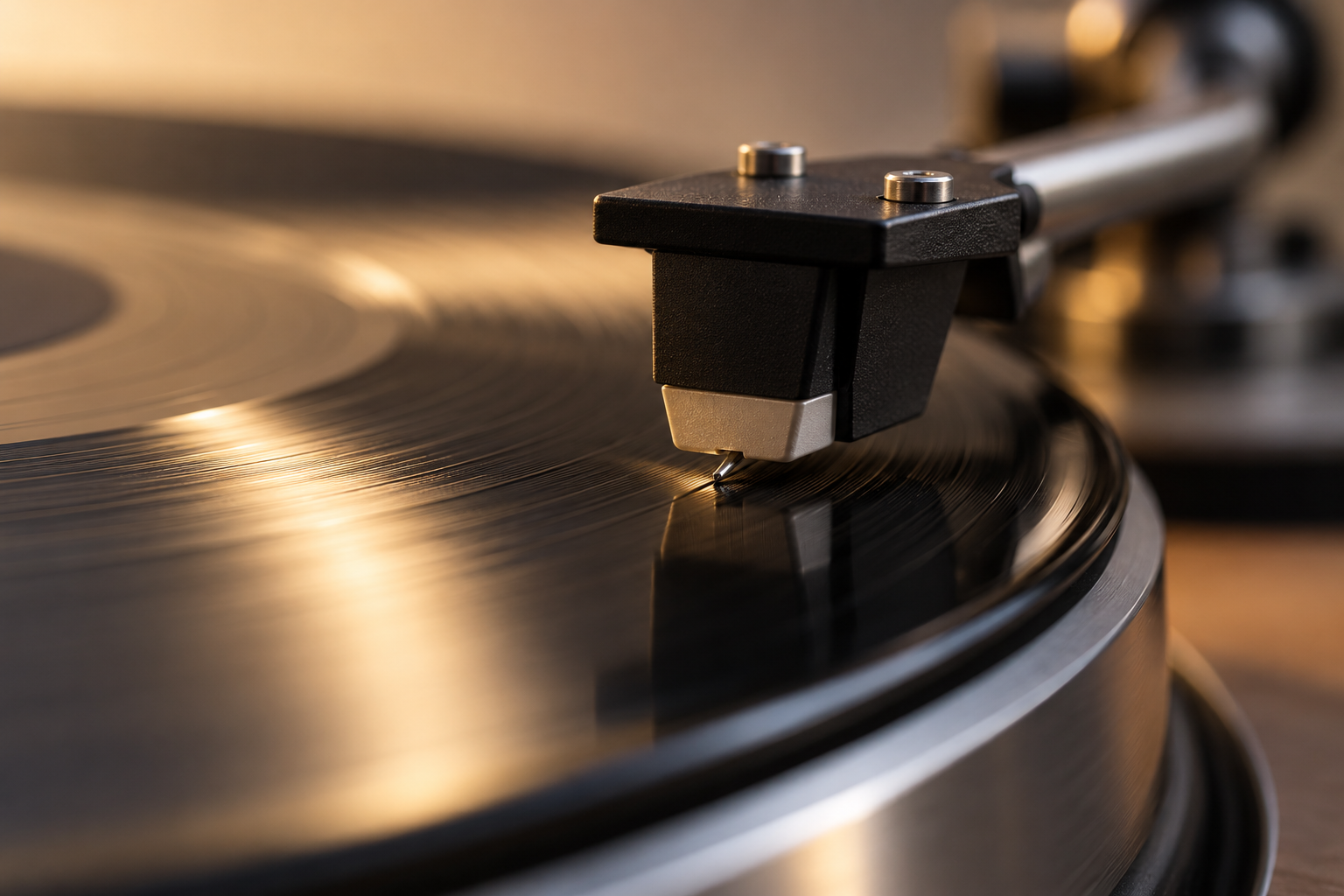
Lower a stylus onto a turning record and the scene seems almost still: a small tip resting on black plastic, a tonearm travelling inward too slowly to see. At the contact point, nothing is still. The record draws a shaped groove beneath the tip. The tip must follow changes in that shape, send its motion through a cantilever, and let a cartridge turn it into an electrical signal. Playback begins as a negotiation between a moving surface and a very small piece of hard material.
The groove is not a row of little drawings of instruments. Its changing path carries the motion from which sound can be recovered. In the Library of Congress's account of optical sound preservation, a specialist describes how an imaging system photographs successive turns and effectively unwinds the spiral. Software follows the groove's movement to extract sound without touching the disc. That work makes a hidden fact visible: the signal is in a continuous, precisely changing route. A playback stylus has to trace that route in real time.
Two walls, one moving tip
In a modern stereo LP, the two opposing sides of the V-shaped groove carry the left and right channel information. Cartridge maker Ortofon's guide to mono and stereo cuts describes the walls at about 45 degrees to the surface. A mono lateral cut moves from side to side; the stereo cut includes both lateral and vertical components. The stylus does not switch between two separate grooves. It moves as one body under the combined shape of the two walls, while the cartridge resolves that motion into two signals.
That is why its fit matters. If a tip rests on a damaged part of a wall, the motion it follows will contain more than the recorded modulation. A Library of Congress and CLIR preservation roundtable describes selecting a larger or smaller stylus for an old disc to ride above or below a worn band of the groove wall. That procedure concerns archival transfers of older records, where groove sizes vary widely. Its principle should not be turned into advice to fit a 78-rpm stylus to a contemporary LP. It shows that contact has a location, and that the location changes what is retrieved.
The tip's movement is passed along the cantilever to the generating system. Audio-Technica's cartridge glossary describes the cantilever as the small suspended arm between diamond and magnets or coils; the cartridge converts mechanical vibration to a signal for amplification. A stiff or heavy part cannot follow every rapid change in exactly the way a massless point would. Nor is a sharper-looking diamond automatically the right fit. Stylus shapes distribute contact along the wall differently, which changes how closely they can follow tight curves and which patch of a worn wall they touch.
Audio-Technica's glossary says its elliptical profile has a narrower front-to-back contact than a conical tip and can trace groove modulation more precisely, especially near the record's inner turns. That describes a family of shapes, not a guarantee that buying one tip will cure every noisy side. Alignment, the condition of the disc, the cartridge's suspension and the cutting of the record still matter. A shape that reaches a less-worn wall on one old disc may meet a different pattern of damage on another.
The same music occupies less road near the centre
A turntable holds its rotational speed approximately constant as the stylus travels inward. The path round a smaller circle is shorter, so the groove moves past the tip at a lower linear speed near the label than near the rim. The same duration of high-frequency sound must fit into less physical length there. This follows from the geometry of circles; it does not mean the music's pitch drops as the arm moves inward. The recorded wiggles become more closely packed along the groove. A finite-size tip and an imperfectly aligned arm have less room to follow them exactly.
The manufacturer's claim for one Microlinear cartridge explicitly singles out improved performance at the inner circumference. That is a claim about that product, not a measured comparison in this article. The underlying challenge is broader than the product: the groove is asking the stylus to trace a demanding pattern at a different surface speed. Inner-groove distortion can also reflect choices made during cutting or a worn disc. It is a symptom to investigate, not proof that all records were pressed badly or that any one replacement stylus is necessary.
The arm must keep the tip in the groove without forcing it beyond what the cartridge and disc can bear. A Library of Congress and CLIR roundtable on disc transfer describes the lower practical tracking force as depending on the groove's modulation, warps, and the dynamics of the cartridge and tonearm. Set too light, a stylus can lose contact and strike the groove again; the report warns that mistracking can damage soft records. Loading a cartridge above its own rating creates a different problem. “As light as possible” is therefore not a safe universal setup rule. The useful setting is one that lets the particular pickup trace the record within its specified range.
On a pivoted arm, the geometry also puts a sideways tendency into the motion. The same preservation report explains that skating force can increase pressure on one groove wall, and that antiskate compensation applies an opposing torque. Audio-Technica's glossary cautions that compensation is a balance, because the record's modulation and the tip's friction are not constant. The point is not to turn one dial into a ritual. It is to keep the two-wall contact as even and stable as the design permits.
The unwanted marks have their own sound
A stylus also meets dust, scratches and wear. A speck lodged in the path can add a click; damage to the wall can change the motion the tip is asked to follow. Cleaning and careful handling help, but a worn groove cannot be restored merely by brushing the surface. The Library of Congress's imaging project exists partly because contact playback can itself change vulnerable recordings. The project has used two- and three-dimensional scans for laterally and vertically cut material, then preserved the images for later analysis. The optical method is not a claim that an ordinary clean LP needs a camera to sound good. It shows the archival value of separating a disc's geometry from another physical pass with a stylus.
The Library's 2019 account of the first Columbia LP is a reminder that “record groove” has never meant a single permanent size or material. Columbia's 1948 long-playing vinyl microgroove let a disc side hold much more programme than a conventional shellac disc, and stereo cutting arrived later. Historical records can require different speeds and different styli. A familiar black LP is one important case inside a longer, varied history of surfaces made to carry sound.
So what does the tip meet? Two modulated walls on a turning disc, at a speed that changes across its radius; a physical fit shaped by the diamond, arm and tracking force; and a surface that carries both the intended signal and the history of its handling. That is why the small act of lowering the arm is consequential. The sound begins before the speaker, where a tiny contact decides which movements it can follow and which it cannot.

A thought worth keeping?