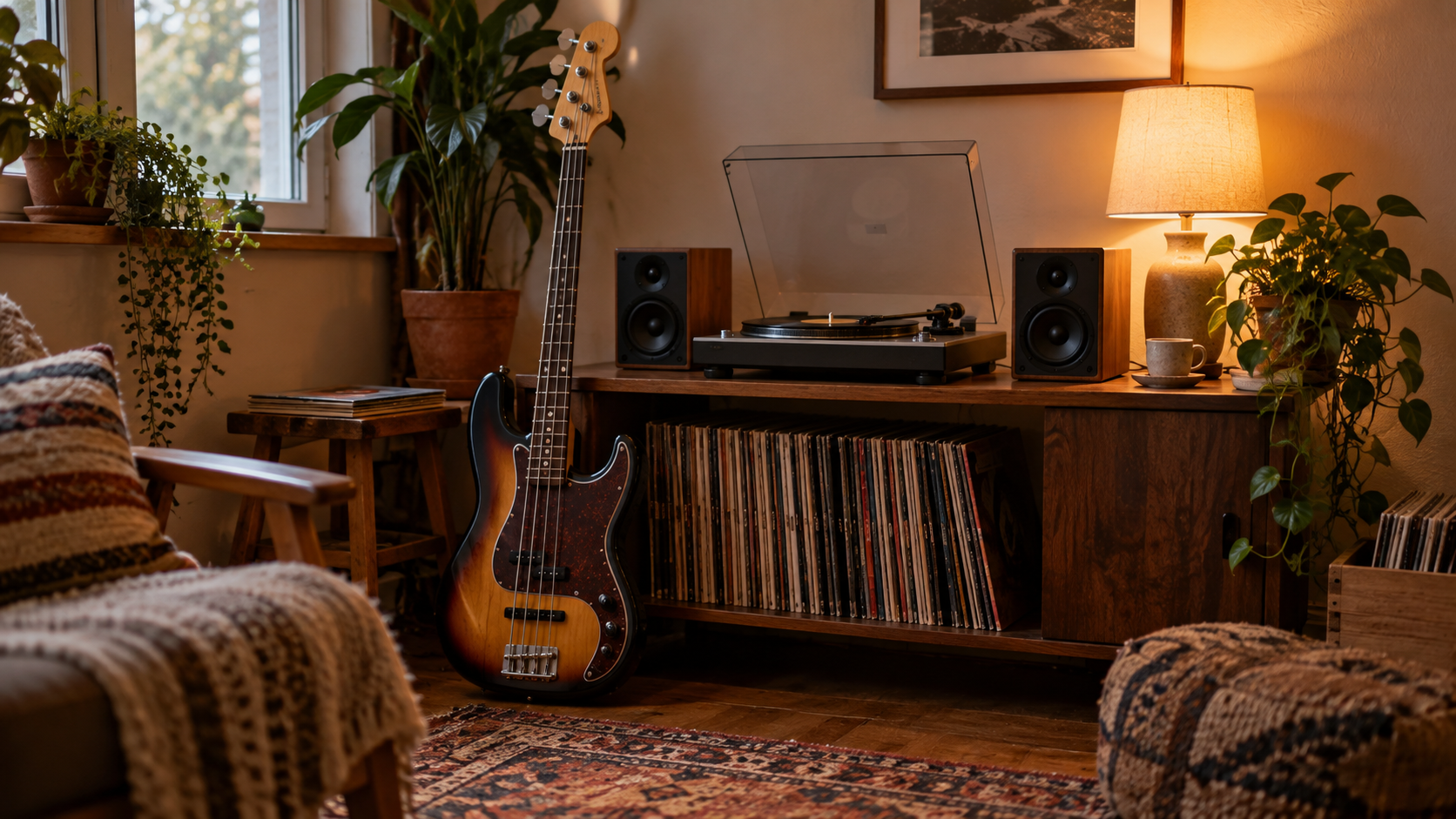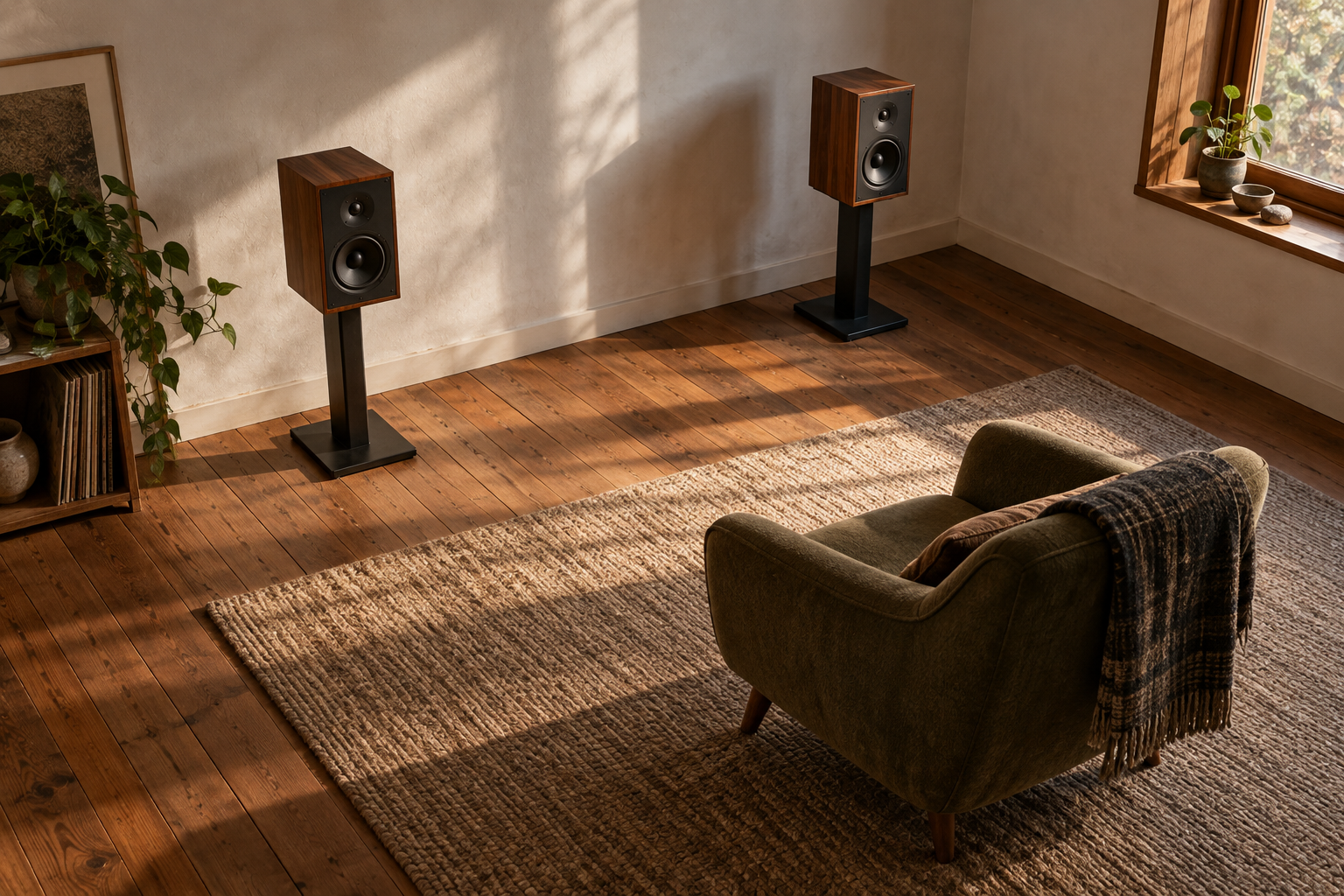
A bass note can seem to vanish from a familiar recording when a chair moves a short distance. The speaker has not forgotten the note, and the file has not changed. The room is adding its own version of the sound: waves that reflect, gather, or cancel at particular places. Moving the speaker changes which of those patterns it feeds. Moving the chair changes which part of the pattern reaches a listener. The position of both objects belongs to the sound.
This is easy to miss because the most obvious place to judge a loudspeaker is directly in front of it. Yet a room has walls, floor, ceiling and furniture around the path from driver to ear. Genelec's placement guide separates two effects that often get folded into the word bass: standing-wave resonances set up by the room's dimensions, and reflections that reach the listening place after the direct sound. They can make one low note strong, another weak, and the same note different at the next chair.
A note that belongs to a place
At a low enough frequency, a sound wave is comparable in length to a room dimension. Energy reflected between surfaces can form a standing-wave pattern, with high-pressure regions and quieter regions. These are room modes. Their frequencies depend on the room; the amount heard depends on where the loudspeaker injects energy and where the listener sits. Genelec's placement account describes both sides: moving a monitor changes which resonances it excites, while moving a listener can take the ears out of a low-frequency null. The explanation is a useful physical model; real rooms have doors, furniture and losses that complicate its simple patterns.
The distinction between source and listener matters. If a note is weak because the listening chair lies in a modal dip, turning up that frequency on an equaliser may make it excessive elsewhere. Genelec's guide to monitor location advises against putting the listening position at the exact centre of the room and notes that moving it forward or backward can escape a modal null. That is an instruction to test positions, not a law that every off-centre chair will be good. A mode in one room may be replaced by another problem a little farther along.
Research on several listening rooms makes the local nature of bass more than a sketch in a guide. In their 2006 Audio Engineering Society study, Todd Welti and Allan Devantier found large low-frequency response differences between seats. They investigated ways to reduce that variation using multiple subwoofers so later equalisation could serve an area rather than one point. Their work does not say a second subwoofer is required for ordinary listening. It establishes why a measurement at a single chair cannot describe the bass everywhere in a room.
The wall behind the speaker has a second route
A different dip can come from the wall behind a loudspeaker. Low sound radiates toward that wall as well as toward the listener. A reflected wave travels farther; when it returns at the wrong phase, it can cancel some of the direct wave. In its room-acoustics guide, Genelec shows how the first cancellation shifts with the distance from speaker to rear wall. The guide's examples place a distance of 0.4 metres near a first dip at 214 hertz and a distance of 1 metre near 86 hertz. These are illustrative calculations for the described geometry, not a promise that a particular living room will produce exactly those numbers.
The practical surprise is that pulling a speaker a little way out from a wall can place the cancellation squarely in the bass. Putting it close to the wall can move that dip higher, while placing it far enough away can make the reflected path weaker relative to the direct sound. Neither move is automatically available in a small room. Genelec also notes that a rear bass-reflex port needs clearance. A Neumann manual for the KH 120 II and KH 150 warns against specified intermediate wall distances for those monitors because of low-frequency response dips. Its distance limits belong to those models and their setup, not every bookshelf speaker.
One wall can also strengthen low-frequency output. Placing a speaker near a solid boundary changes how it radiates into the room. The Neumann acoustics FAQ calls this boundary loading and distinguishes its broad bass increase from a narrow cancellation caused by a reflection. A room may have both: more low-frequency level overall and a sharp hole at one note. That is why the advice “move it closer for more bass” is incomplete. It may improve one part of the response while changing another.
When a control can help, and when it cannot
An equaliser can turn down a strong peak. It cannot reliably rebuild a deep cancellation made by two sounds arriving out of phase at the listening spot. Raising the speaker's output also raises the reflected sound that cancels it. Both Genelec's explanation and Neumann's FAQ put the remedy for a reflection dip in tracing the surface, changing placement or treating the reflection. The same sources describe controls for broad boundary gain. A control is useful after the physical cause has been identified; it is not a substitute for finding it.
That physical cause can be hard to name from one favourite track. A kick drum changes from hit to hit, and a bass guitar moves through notes with different overtones. A simple sequence of low test tones, played at a moderate level, can make the unevenness easier to notice. A calibrated microphone and frequency sweep make it visible. Genelec's GRADE measurement description distinguishes peaks and notches in the in-room response before calibration and shows a measured notch that may come from a hard-surface reflection. A graph does not identify the responsible wall by itself. It gives a frequency and a repeatable observation to test while the speaker or chair moves.
The experiment needs one change at a time. Keep the listening level and track or test signal the same. Move a speaker, then compare the same notes from the same chair. Return it and move the chair instead. If a narrow weakness follows the chair, a listening-position effect deserves attention. If it shifts when the speaker's distance to a wall changes, boundary interference becomes a stronger explanation. These are diagnostic clues, not a way to certify a room without measurements; several modes and reflections can overlap.
Stereo brings another constraint. Moving one speaker to cure a bass dip may make the left and right sides less alike. Genelec's placement guidance recommends equal distances to nearby boundaries and a central listening axis for a matched stereo pair, so the reflections and imaging remain more similar. In a shared room, a perfectly symmetrical layout may be impossible. The aim is to understand which compromise a movement buys, not to chase a single bass number while the rest of the music loses its shape.
The same note can be full near a wall, thin in the middle of the room, and ordinary a step beyond. That change is a useful observation before it is a fault to fix. It says the recording and loudspeaker are only two parts of a chain that ends at a particular pair of ears in a particular place. Mark the places where the note changes; move one thing; listen again. The room will still be there, but it need not remain an invisible participant.

A thought worth keeping?